
To assess landscape change, we analyzed a 41-year Landsat time series using a machine-learning approach that incorporated temporal transfer learning to detect patterns of freshwater marsh degradation and saline wetland transgression (model accuracy: 59%-80%).
When salt meets restoration: shifts in salinity levels reshape coastal wetlands under rising seas
Research by Dr. Boya Zhang
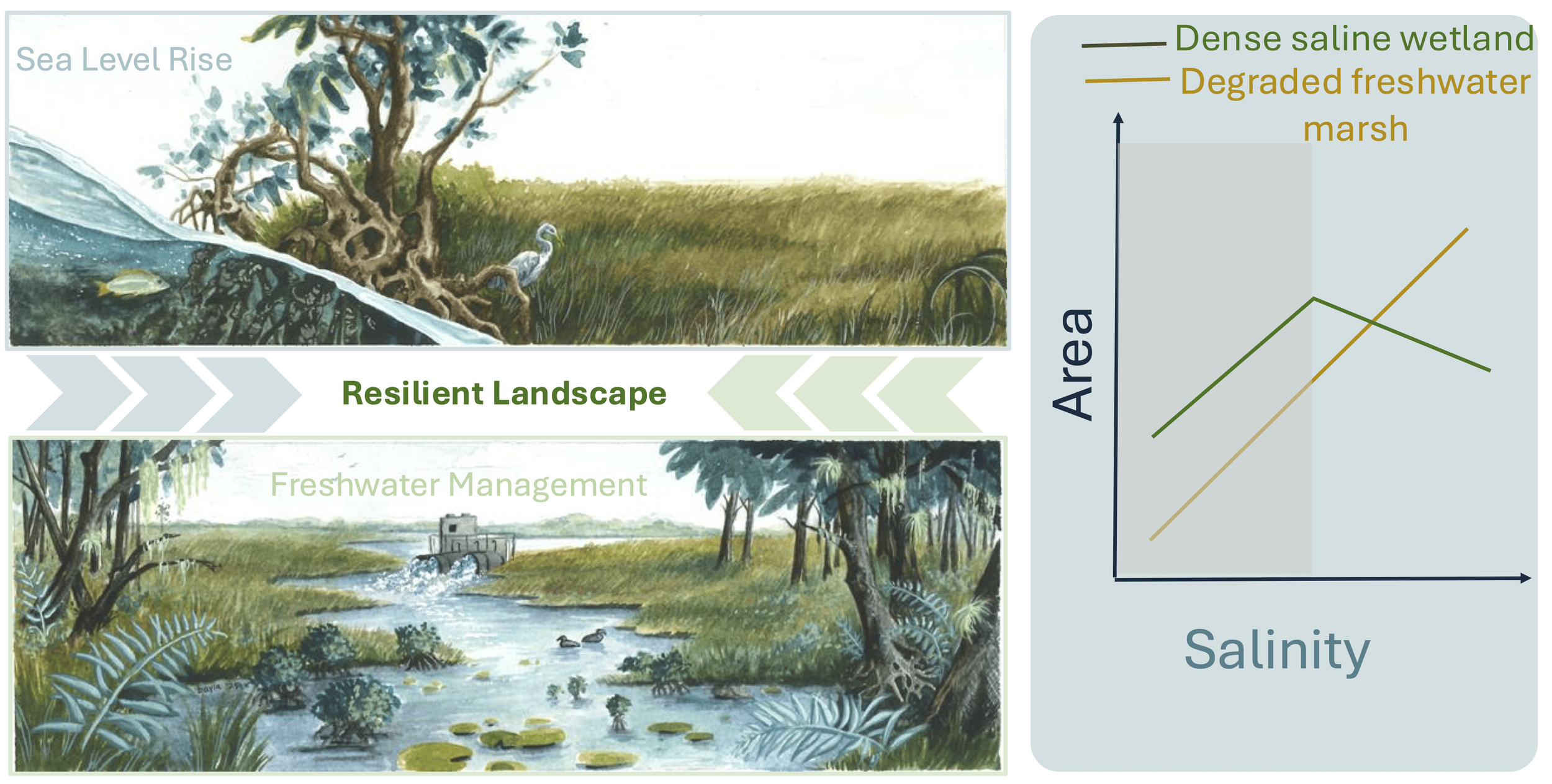
In response to sea-level rise (SLR), saltwater intrusion reshapes freshwater marshes by driving degradation. Although increased salinity facilitates the transgression of salt-tolerant vegetation along coastlines, high salinity can suppress productivity and lead to vegetation retraction. Despite the significance of these processes in reshaping landscapes, their combined impact has rarely been assessed when they occur simultaneously. The Southeastern Saline Everglades (182.9 km²) is a landscape affected by climate change, SLR, and freshwater management, where freshwater flow has been enhanced since the 2010s through the Comprehensive Everglades Restoration Plan (CERP), the largest wetland restoration effort to date.
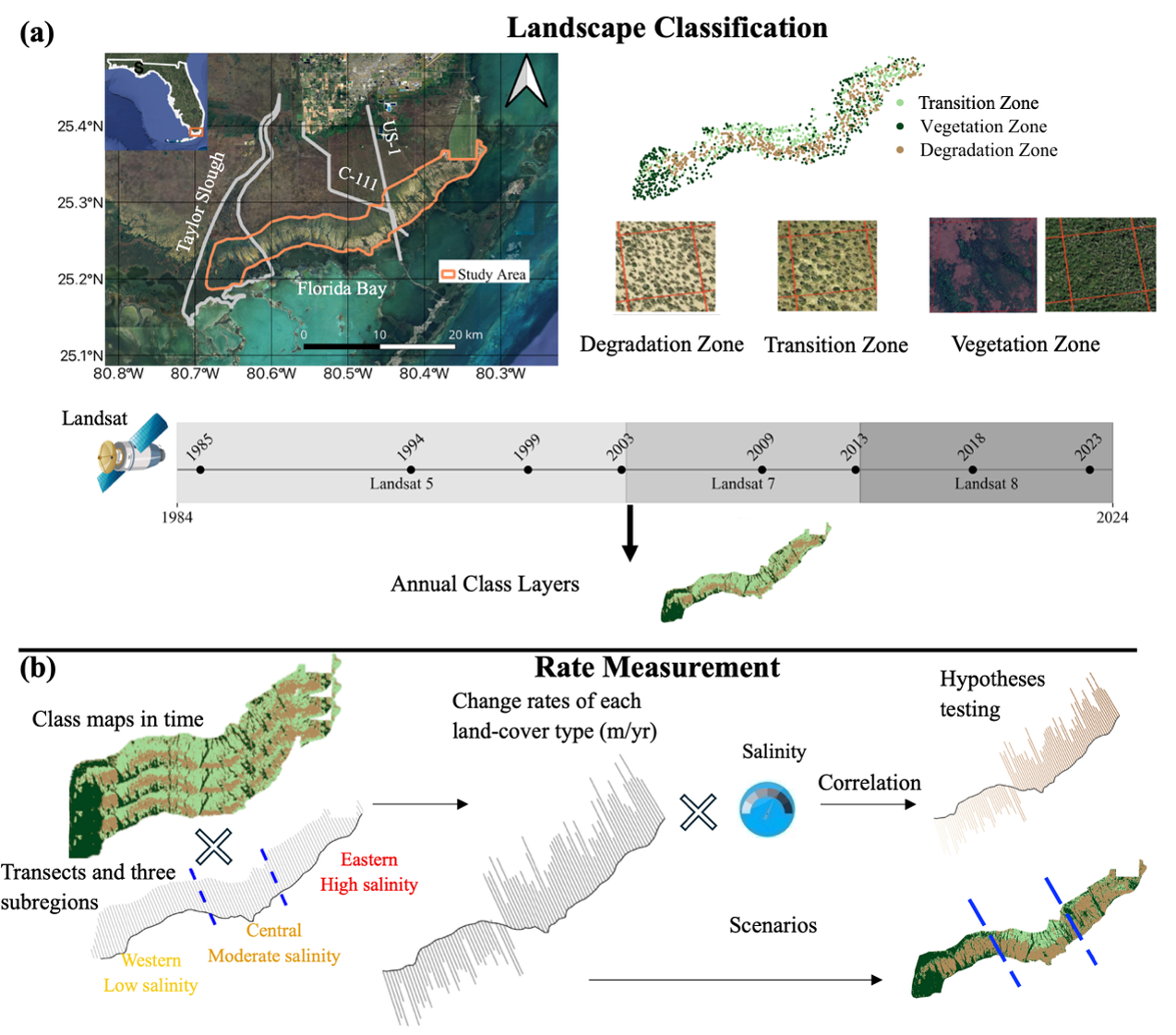
We first classified the landscape into three land-cover classes along a gradient of vegetation density: a low-density degraded zone (DZ), a transitional zone (TZ), and a high-density vegetated zone (VZ).
The DZ was characterized by sparse vegetation cover, low aboveground biomass, and susceptibility to coastal erosion due to reduced vegetation-mediated sediment stabilization. In contrast, the VZ represented areas of dense wetland vegetation, and along the coastline, the expansion of this zone indicated mangrove transgression. The TZ represented a transitional stage between degraded and densely vegetated environments.
Using annual layers covering three hydrologically distinct subregions, we (1) estimated rates of change for each land-cover class along transects, (2) tested hypotheses by correlating annal mean salinity with the annual land-cover coverage at a transect-level, and (3) explored future scenarios.
Download our data!
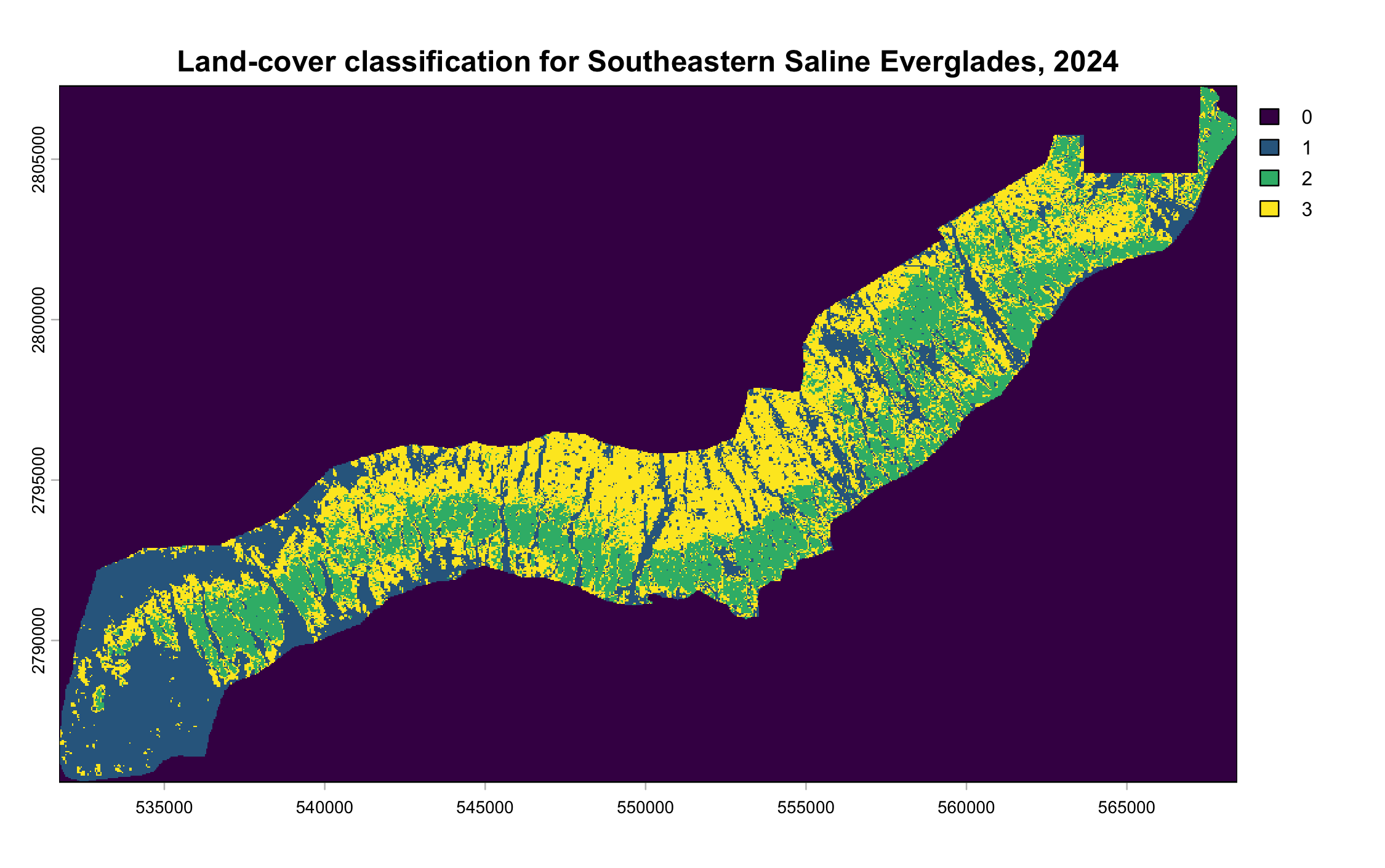
To download the Southeastern Saline Everglades annual land-cover classification layers from 1984 to 2024, visit the dataset landing page by clicking on the button below.